Skip to Content

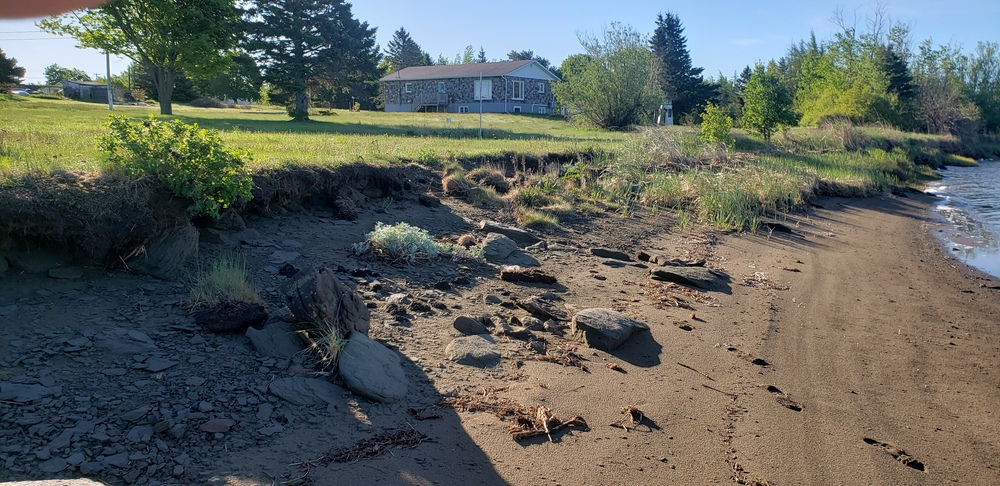
The Living Shoreline Project aims to restore a public property to a more natural state by establishing a designated area where native plants can grow naturally. In the long term, this restoration will help reduce shoreline erosion and contribute to the protection of biodiversity.

As part of this project, a safe and public water access ramp will also be developed to allow citizens to safely enjoy water-based activities while respecting the natural environment. The site will also include parking and a trail leading to the water.

Follow the project's progress here!

  • The Living Shoreline Method is an approach that uses natural materials, such as plants, to protect and stabilize coastlines. By adding organic matter such as leaves or seaweed, we promote a continuous natural cycle that enriches the soil, nourishes plants, and restores the land. A diverse range of plants also attracts a variety of wildlife that feeds on seeds and small fruits. In turn, these animals help replenish the soil and contribute to the natural dispersal of plants, supporting a healthy and resilient coastal ecosystem.

    The goal of the Living Shoreline Method is to restore a site so that it resembles its natural state as closely as possible. The vegetation that survives is the vegetation best adapted to the local climate. By allowing plants to grow naturally, we can identify the native species already present on the site. This information is very valuable when selecting which species to plant during the restoration process. In addition, allowing vegetation to grow helps reduce erosion by absorbing the energy of waves and water, while also promoting water infiltration into the soil rather than surface runoff into the shoreline.

    Plants help protect the site from erosion in several ways. Their leaves intercept rainfall, reducing the force and speed of water as it reaches the ground. Plant roots also play a vital role in preventing erosion. The more vegetation there is, the less water runs off the surface; instead, it is absorbed by plants or infiltrates into the soil. Plants with more extensive root systems, such as shrubs and trees, are especially effective at stabilizing the soil. Their roots help bind the soil together, making it more resistant to erosion.

    Native plants are species that occur naturally in a region without human intervention. They are well adapted to the local environment. Many animal species have evolved alongside these plants, relying on them for food, shelter, and habitat.

    Native plants are essential to projects like this because they help protect local biodiversity, are more resilient to local conditions, require less maintenance, and increase the likelihood of a successful restoration. Since they are naturally adapted to the local environment, they establish more easily and contribute to a healthier, more sustainable ecosystem.

    As part of this project, the vegetation consists primarily of grasses and shrubs. Shrubs help stabilize the soil because their root systems are more extensive and robust than those of grasses. They also remain shorter than trees, which is often preferred by waterfront property owners who want to preserve their view of the water.

    Trees can also be used in this type of project. They simply need to be pruned once they reach a certain height. Pruning does not harm the trees—it only limits their height. The advantage of this approach is that the trees retain their extensive root systems, which are highly effective at stabilizing the soil and reducing erosion.

    Erosion is a natural process. It plays an important role in nourishing beaches and creating essential habitats for many plant and animal species. For example, some species, such as the bank swallow, depend on natural shorelines for reproduction.

    There are several ways to reduce the effects of erosion. Depending on the characteristics of a site (waves, wind, storms, rainfall, etc.), different approaches can be used:

    • Green methods, which rely primarily on vegetation

      Using plants to reduce the effects of erosion offers several advantages. Their roots help hold the soil in place, absorb some of the energy from waves, and support local biodiversity. Their foliage intercepts rainfall and reduces its impact on the soil, helping to lower the risk of erosion.

    • Hybrid methods, which combine plants and rocks

      In this approach, rocks protect shorelines from the strongest waves, while plants improve long-term stability by holding the soil and rocks in place with their root systems.

    • Grey methods, which involve building rock or concrete structures

      This approach can have significant environmental impacts. When rocks are needed, a hybrid approach is often a better option because it helps reduce environmental impacts.